
30th Anniversary – 1984

Posts are listed in chronological order based on date of posting – newest posts first.

After running the camp for 14 years, Bert offered to sell the property to the Borough of North York in 1970 for $1.5 million.
At the time, the North York Board of Education was leasing the property 10 months of the year for $50,000. It is not clear whether Bert intended to continue operating the camp by leasing the property for 2 months of the year.

The proposal was reviewed according to minutes of the November 23, 1970 North York Council meeting:

North York declined the offer.
By 1976, the offer price was $2.3 million. Bert filed an application to subdivide the property and build 50 houses. Filing this proposal supports the idea that Bert was ready to recoup his land investment and close the camp. Building houses would obviously require a huge capital investment and would take years to realize profits tied to the rise in property value. Selling the land alone would obviously be easier. It is possible that Bert submitted this proposal believing this it would not be welcomed by council, giving them geater incentive to accept his offer.
In April 1977, the borough declined once again over concerns about how local residents would react to having a public park in the neighbourhood.


In 1981, a request for a zoning amendment was made to North York Council to permit the redevelopment of the site into a subdivision:

Approval was denied.

In 1986, The Toronto and Region Conservation Authority purchased the property for $3.5 million. As part of the agreement, the camp retained use of the main office building and was given a 7-year lease to continue operating through the summer of 1993. The annual lease rate was $18,000.


Efforts to renew the lease in 1991 were unsuccessful. In 1992 an offer to renew the lease was extended, however the lease rate was excessive. It was determined not to be economically viable – especially in light of recently declining enrolment.
The camp ceased operation after the summer of 1993.
In 1981, a proposal to redevelop the valley lands was denied by North York Council.


The image below shows the property lines of the camp on the original 1956 survey:

The survey lines overlaid on a 1983 aerial photo:


Cleaning and maintaining the pools was an annual chore. The concrete pools were prone to cracking with the freeze/thaw cycle. For many years, the I-Pool had a crack all the way along the bottom. The pool leaked and required regular filling. Many pools required annual painting.


Pool decks were also prone to cracking. In the late 80’s the decks around the T-Learners were replaced with paving stones as they could no longer be maintained.


When some cabins began abusing these activities by doing them every day and several times a day, a limit had to be enforced!


Bert – late 1960s:

1980s:


Addendum:


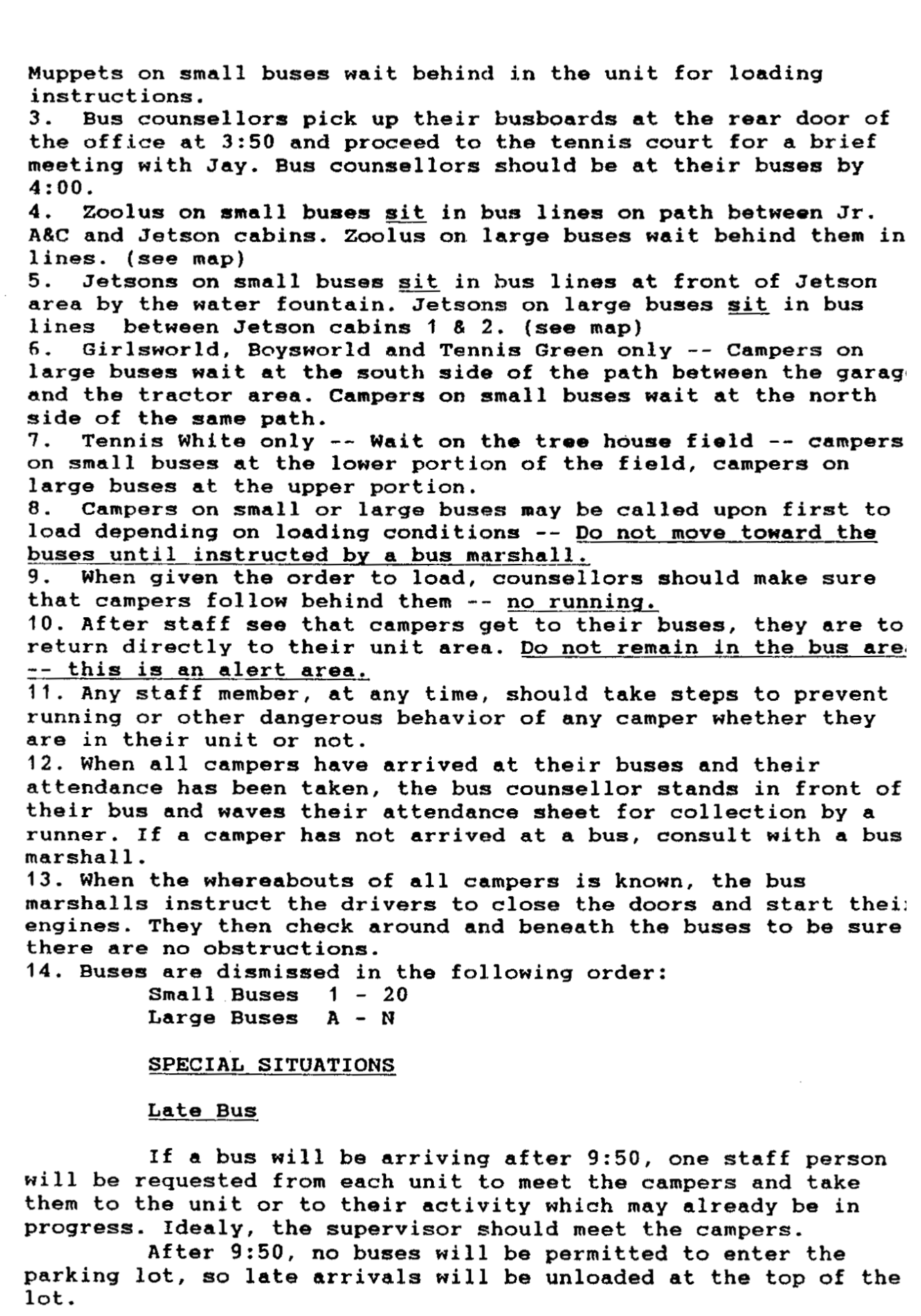
Arrival & Departure Routines – 1988



Daily Bus Attendance Form

Welcome Letter to Bus Drivers – 1988


Bag Delivery Day Procedures


Evidence does not support the fact that Bathurst Manor Day Camp was the first day camp in North America and it is uncertain who made this determination in presenting the award.
While it was certainly one of the earliest in Canada, it was preceded by Camp Robin Hood, which was established 10 years earlier, in 1946.
Some history of US day camps can be found here: https://www.acacamps.org/article/camping-magazine/years-adventures-challenges-history-day-camp
Update: 2026
There was also an alternate version of this article:

There was a correction made to each of articles – specifically changing “First” day camp to “Largest”:


